DE DE EN EN RU RU

Where is Felix?

DE DE EN EN RU RU

Chronology

28. December 1984
1984

It was a Friday, a cold and damp winter’s day in Dresden. We needed a few bits and spontaneously decided to go on a little shopping trip to the city centre. Our destination was the CENTRUM department store on Prager Strasse.

We lived on Louisenstrasse, so the quickest way to the city centre was the number 11 tram from the stop on Bautzener Strasse/Rothenburger Strasse. We were able to get off the tram a few stops later directly opposite the CENTRUM department store at the stop on Prager Strasse. We naturally took our 5-month-old son, Felix, with us.

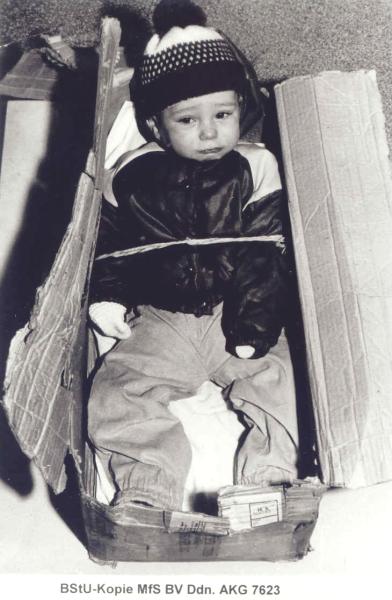
We reached the CENTRUM department store at about 4 p.m. Felix was fast asleep in his pram. The CENTRUM department store also had a separate entrance on Waisenhausstrasse. There was a care facility for small children and babies operated by the store a few metres from this entrance with a separate access point. Unfortunately, all the spaces were occupied. So, we left our pram between the entrance to the care facility and the entrance on Waisenhausstrasse. There were already a few other prams here with sleeping babies. Felix was fast asleep.

When we returned from our shopping expedition 30 minutes later, we could not believe our eyes:

FELIX HAD DISAPPEARED! The pram was still in the same position, but it was empty.

Please note: Leaving a pram in front of a store or a different shop was absolutely normal in 1984. There was not much space in stores and shops back then and prams could not be taken inside.

One of the biggest police operations in the history of East Germany started a few minutes later. All the available officers in Dresden were mobilised and deployed, and the “Felix” special task force involved more than 40 officers during the first few weeks.

Investigations continued in every conceivable direction, including:

  • families where applications for adoption had been turned down;
  • people who had already been linked to child abduction in the past;
  • women who had suffered a stillbirth or miscarriage;
  • the CID (Criminal Investigation Department) also focused on us at the start of their investigations. Were Felix’s parents trying to cover up a crime?

The East German community police officers and their voluntary helpers, the riot police and even the transport police as well as workers from the Ministry of State Security left practically no stone unturned in Dresden to rule out the possibility that Felix had been abandoned somewhere. They also conducted interviews and questioned people with the goal of obtaining information about the sequence of events.

This and a great deal more was done, but sadly without any tangible results. The head of the special task force, Ekkehard Schuldt, commented on this, saying, “We had nothing, absolutely nothing, no leads.”

Saxon newspaper, 29 Dec 1984 Saxon newspaper, 31 Dec 1984
06. January 1985
1985

A little boy was found in the hallway of Friedrich-Engels-Strasse 11 in Dresden (now Königstrasse 11) at about midday – but it was not Felix!

Nobody reported that the boy was missing! Nobody knew his name. The little nameless boy was examined at the children’s clinic of the “Carl-Gustav-Carus” Medical Academy in Dresden to clarify his identity and assess his physical health.

Found child
08. January 1985
1985

The head of the children’s clinic submitted his report about the foundling.

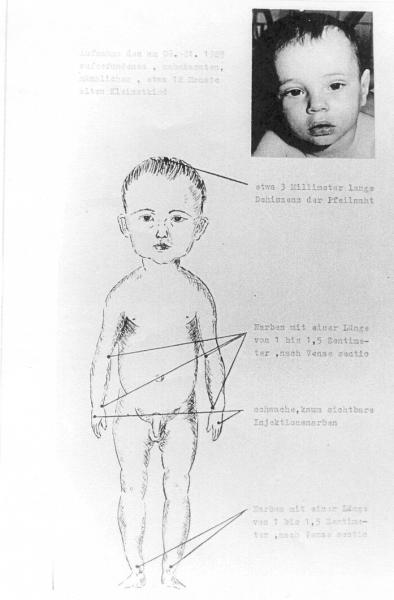
The abandoned child was believed to be about 12 months old. His age was determined by the presence of 8 milk teeth, his general state of development and assessing his age using the so-called “carpal bone method”.

The doctors discovered that the foundling must have undergone intensive medical care and infusion therapy during the first few weeks of his life.

The surgical method used to open the foundling’s veins to administer the infusions was not typical of the technique used by the East German health services. It seemed to be “rough”, and the examining doctors believed that a doctor without any special training for microsurgical procedures, which would have been appropriate for very small children, might have opened his veins.

Overall, scars from vein openings were found at 6 points (crooks of the arms, wrists, ankles). A drawing sheds some light on the precise location of the “venae sectia”.

Medical report on the found child, 8 Jan 1985 Medical report on the found child, 8 Jan 1985 Saxon Newspaper, 8 Jan 1985 Saxon Newspaper, 9 Jan 1985 «Neues Deutschland» newspaper, 10 Jan 1985
10. January 1985
1985

Based on the medical reports about the foundling and other investigation results, the military state prosecution service of the East German army approached the military state prosecution service of the group of Soviet forces in Germany with a request for assistance.

11. January 1985
1985

The head of the Dresden regional office of the Ministry of State Security, Major General Böhm, approached the head of the Soviet Military Defence at the 1st Guards Tank Army in Dresden, Colonel Ilyin, with a request for support in solving the child abduction and abandoned child.

BDVP wanted poster, 15 Jan 1985
01. February 1985
1985

Here is an extract from the notes of the military state prosecution service in the East German army (Colonel Müller, Military State Prosecutor) on 1 February 1985:

“Colonel Teryochin (the Deputy Military State Prosecutor for the Soviet forces in Germany) reported the following as regards the request for assistance sent to the Military State Prosecutor of the Soviet forces in Germany on 10 January 1985 in connection with the child abduction/abandoned child in Dresden on 31 January 1985:

3. It is assumed that the abductors have already left East Germany with the child (our Felix is meant here!!) and are now in the Soviet Union. … The group’s military state prosecution service assumes that there is a direct link between the abduction of the child and the abandoned child and the perpetrators come from the Soviet forces in Germany.”

Please note: As Felix’s parents, we only learnt about this note in the file by studying our Stasi file in the early 2000s.

Saxon newspaper, 01 Feb 1985
27. December 1985
1985

The Dresden CID’s child abduction task force drew up its final report. All the measures adopted were briefly listed, and the results were summarised. “As we have currently exhausted the forensic tools and opportunities to solve the crime and there are no reasonable prospects of identifying the unknown criminals, we suggest that we provisionally close the investigation procedure according to Section 143 No. 1 of the East German Code of Criminal Procedure.”

February 1986
1986

The state prosecutor in the city of Dresden and the head of the “Felix” special task force told us in a personal conversation that the investigation proceedings had been closed. The reason was brief: There were no other promising investigative methods available; all the options had been exhausted.

We had already gradually lost hope of getting Felix back in the short term or at all during 1985. We were still young and did not just want to have one child anyway. Mother Lenore was therefore already pregnant again when she sat at the table for the discussions in February 1986. Fabian was born in June.

August 1988
1988

Our daughter Nadja was born. We were a happy family.

1989 / 1990
Turn

The fall of the Berlin wall and the reunification of East and West Germany created enormous private and professional challenges for us. Our search for Felix took a back seat.

28. December 1999
1999

Our business was prospering 10 years after the fall of the Berlin wall, our children had already left primary school and were attending a grammar school. Felix then became a greater priority once again.

As a first step, we wanted to talk to the head of the former special task force, Mr Schuldt. We hoped to gain some insight into the investigation work performed back then.

Please note: Even though we were people affected by the criminal proceedings, we were not informed about the content of the investigations.

We had some information that Mr Schuldt had been working for the CID in Rostock for some time. We managed to contact him, but Mr Schuldt was very reserved at the outset. He only agreed to meet us after several telephone conversations.

Saxon newspaper, 1999
July 2000
2000

We decided to make an application to relaunch the investigative proceedings as regards the child abduction, which were halted in 1985.

January 2001
2001

Dresden state prosecution service rejected any resumption of the investigative proceedings without stating any reasons that we could verify.

We lodged an appeal against this negative response. As a result, we obtained the reasons why the resumption of the case had been rejected from the state prosecutor, Mr Avenarius, in August 2001:

The crime was already subject to the statute of limitations according to German law.

The state prosecutor, Mr Avenarius, allowed us to privately inspect the investigation files. We spent several days viewing the documents filed in 12 removal boxes.

May 2001
2001

We made an application to inspect our Stasi file for the first time. We were already familiar with very many of the documents presented to us by the authority – they were copies of the CID’s investigation files.

However: the East German Ministry of State Security had clearly investigated the case with intensity and great focus. The employees apparently wanted to show the CID that they were the better investigators.

And: the former head of the district state security authority, Major General Böhm, had left a hand-written note on the top of the closed file: “Please keep safe!” This matter was obviously very important for him.

23. August 2001
2001

The child abduction as a crime was subject to the statute of limitations. We had to accept this fact.

Despite this, we missed our son, Felix. Was there another way of making the authorities act on our behalf?

Yes, we did not file a missing person’s report in December 1984. We did so at Dresden central police station during the afternoon of 23 August 2001.

The CID was not thrilled by this. We had to exert some pressure for them to reopen the old files.

10. July 2002
2002

The Dresden CID directly approached Interpol Russia. We quickly received the information that the enquiries should be directed using the normal official channels – i.e. via the state prosecution service and the Ministry of the Interior etc.

03. March 2003
2003

The 1st Russian TV channel invited us to be guests in their “schdi menja” (Waiting For Me) broadcast for missing persons. The broadcaster’s Germany correspondent, Oleg Migunov, filmed a short report with us in Dresden as the introductory clip for our TV appearance.

All took place on 17 March 2003. We answered the presenters’ questions and had the opportunity of asking our questions to the studio audience and the public watching on their televisions.

Although the broadcast regularly attracts 20 million viewers in Russia and neighbouring countries, we did not receive a single lead for our ongoing search.

21. May 2003
2003

Dresden state prosecution service sent a detailed request for legal assistance to the military state prosecution service in Moscow.

02. February 2005
2005

We knew that Chancellor Schröder and his wife were friends with the Putin family. So, we sent a personal request to Mrs Schröder-Köpf. We asked her to discuss our family situation with Mr Putin and ask for his support.

The response came quickly and was NEGATIVE. She did not want to help us. Our request, which we sent again in detail in the middle of May, was curtly rejected by her office manager without any emotion.

16. May 2005
2005

We received the information that the response to the request for legal assistance dated May 2003 had arrived at Dresden state prosecution service – and it involved 120 pages! Anybody who inspects this document can see that a great deal of work had been done.

It included definitions of tasks, records of interrogations, even birth certificates and contracts of employment without anything being blacked out – and in the middle, the address of the man who was accused of having abandoned the cardboard box with the foundling in the hallway of Friedrich-Engels-Strasse 11: Mr Sultanov lived in Ufa!

But was there also an answer to our question: “Where is Felix?” – No!

04. October 2005
2005

We went to the state prosecution service with the filmmaker, Knut Vetten, to learn about the response to the request for legal assistance. Knut Vetten was the first German filmmaker to get us in front of his camera. The report was broadcast on MDR television in November and triggered many different responses. We were able to reveal a long-held and well-kept secret in this way. Up to this time, only our families, very close friends and naturally the CID and the state prosecution service knew about what had happened to us in December 1984. A large German audience learnt who the parents of Felix were through the film broadcast on MDR for the first time.

Knut Vetten managed to arrange an interview with Mr Sultanov in Ufa. His facial expression, his gestures, his way of responding and his entire demeanour towards the cameraman only suggested one conclusion: the man was very familiar with the topic, but did not want to say anything or could not or was not allowed to. He was obliged to maintain silence.

10. October 2006
Politics

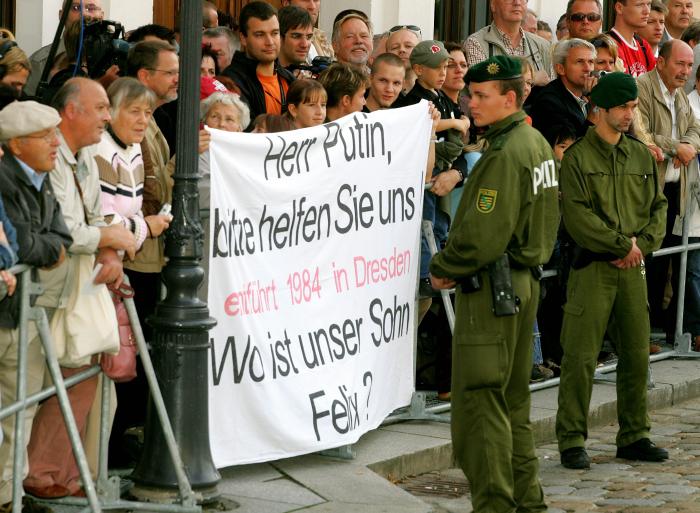
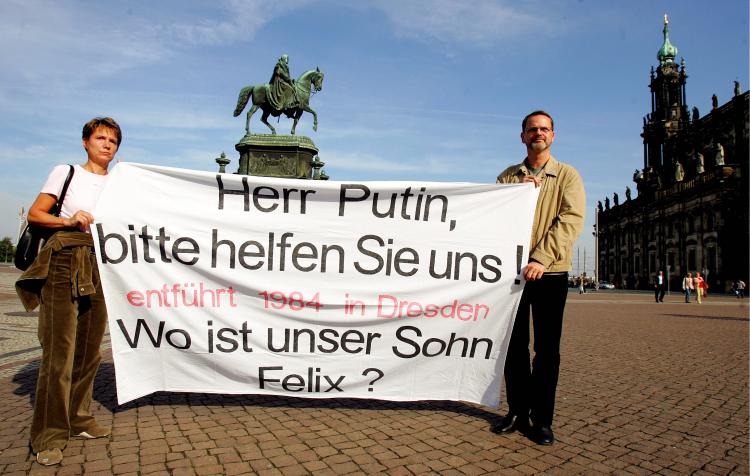
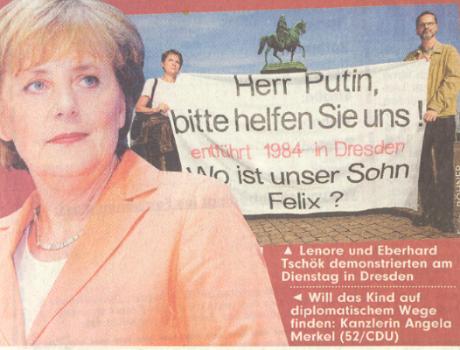
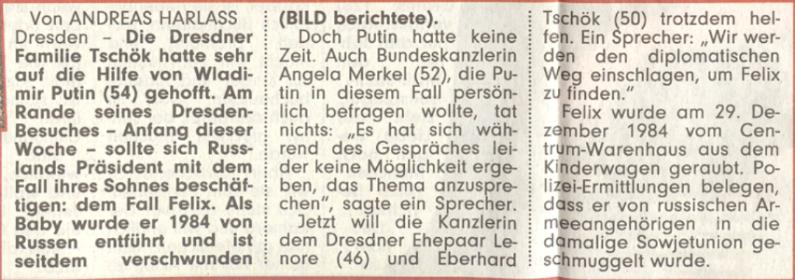
The “Petersburg Dialogue” forum was held in Dresden. The President of the Russian Federation, Vladimir Putin, was expected to attend as a guest. We positioned ourselves at a key point in the Taschenberg area with a missing person poster so that Vladimir Putin could not avoid seeing us.

When he got out of his car, he did not look in our direction. But Lenore’s powerful voice unmistakeably rang out across the square, “Mr Putin, please help me find my son!” We were certain that Mr Putin both heard and understood the sentence. We were also convinced that his advisors had “warned” him about us during his journey to the Green Vault, and that is why he deliberately ignored us. He knew all about the story!

Thanks to our public appearance, people started to take more notice of the “Where is Felix?” issue again. We received help at a political level up to and including the Chancellery Minister, Thomas de Maizière.

Wanted poster, 2006 Wanted poster, 2006 Chancellor Angela Merkel From the newspaper «Bild», 13 Oct 2006
13 December 2006
Politics

The former German Chancellor, Gerhard Schröder, was signing his book entitled “Decisions: My Life in Politics” at the Book Centre on Prager Strasse. We joined the queue to have our book signed too.

Instead of a book, we handed over a letter to Mr Schröder, asking him to support our cause with Mr Putin. Mr Schröder was visibly irritated, but accepted the letter. His office responded within three weeks. This response did not help us any further, because Mr Putin did not see our request for assistance.

04. January 2007 – We got to know Martin
2007

What goes on in a young man who discovered as a child that he was adopted and later realised that this was only part of the story?

The whole truth is: his parents treated him as an undesirable object, abandoned him and took something “better” for themselves! Individuals do not willingly want to face up to this. As a result, some time passed before we were able to get to know the foundling, Martin. He had suppressed his story and focused on his life. We fully understood and still understand this. However, it was important for us to personally get to know the young man.

End of 2007 – Beginning of 2008
Media

We were able to ensure that the CID and the state prosecution service once again picked up our case. The Russian state prosecution service sent the medical records of five boys who were treated in the intensive care unit of a Dresden military hospital for the Soviet forces on account of acute, serious illnesses in 1983 – 1984. Dresden state prosecution service arranged for checks to be conducted on whether there was a connection between the treatments administered and the operative scars found on the boy who was abandoned on 6 January 1985.

Russian media took up the story in a big way. Extensive articles in various national newspapers, reports in the main news programmes of TV channels and a fairly long magazine article in the “Maximum” series on NTV Russia published our story in Russia and neighbouring countries.

29 and 30 January 2008
Moscow

We flew to Moscow for two days at the invitation of the NTV Russian channel. We had engaged in a dialogue with the channel about the abduction of our son, Felix, in our home town of Dresden in November 2007. NTV offered to arrange an appointment with the responsible Russian state prosecution service and accompany us during this appointment.

The head of the investigation team, Judiciary Colonel Generalov, received us in his office on 30 January 2008. During frank discussions, he told us about the task given to his investigation team. He confirmed, when we asked, that President Putin had personally commissioned the task. All the young men from the birth period in question, whose births had been registered by the registry offices of the Soviet forces’ garrison headquarters in East Germany, were being checked. This measure consumed a great deal of time so that a final result could not be expected immediately.

Please note: The registry offices of the Soviet forces’ garrison headquarters in Germany documented about 8,000 births in all every year. It was therefore necessary to find about 4,000 young men from two years of births and question/check them. It was doubtful whether it would be possible to find all 8,000. The Russian resident registration system is porous, not all the officers and civil employees came from Russia, and many families from the CIS sought their fortune abroad outside the CIS after 1990.

This conversation reassured us that the Russian authorities would do all in their power to process the request for legal assistance from Germany until they achieved some success. We returned home in an almost euphoric mood.

13. February 2008
TV

We faced the questions from Günther Jauch in the RTL series, “Stern TV”, and reported on our latest experiences, the new findings and the reasons for our strong optimism that we would find out where Felix was and how he was within a reasonable period of time.

20. July 2009
DNA

The Institute for Forensic Medicine at the Medical Academy in Dresden examined Martin’s items of clothing stored at the CID using the latest investigative methods for DNA material and struck gold! Microbiological material from Felix was found on Martin’s things.

It was finally obvious that Felix and Martin had been exchanged.

30. Dezember 2009
Media

The Russian weekly, “Argumenty i Facty” carried a report about our story in detail and our 25-year search for Felix in its international edition no. 1/2010, which appeared outside the CIS countries. It planned to publish this article, reinforced with readers’ comments and a statement by the relevant Russian state prosecutor, in the CIS countries and on Internet portals at the end of January or at the beginning of February 2010. Would this achieve the breakthrough?

14. September 2010
Reward

A key birthday would take place in our family next week. Felix’s mother would celebrate her 50th! It was sad, but she had spent more than half her life without her first son and still did not know whether he was still alive. It would be the same story for Felix’s father in two years’ time. Would we resolve this situation by then?

We now knew the names of about 15 young men whom the Russian state prosecution service had selected as potential “Felix” candidates, but the DNA samples were all negative.

Because the straws that we could clutch at were becoming rarer and more and more fragile, we decided to increase the reward for any key information to EUR 10,000.00! May God help us!

08. Januar 2011
Obituary

Obituary!

We received some information about a young man who might well have been Felix exactly three years ago. He was called Sergey and was living in Kaliningrad. His work colleague informed us about an episode at that time, from which he had concluded that Sergey could be our son.

We had not managed to transport a DNA sample from Sergey to Germany since receiving this information in 2008 and so confirm the suspicion or not.

We learnt today on the Internet that Sergey had died in tragic circumstances on 16 December 2010.

Although we could not get to know you, we will remember you and also try to solve the issue that interests us, even after your death. We mourned Sergey’s passing.

Sergeij from Kaliningrad
19. March 2011
Investigation

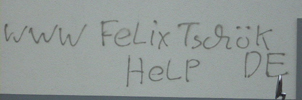
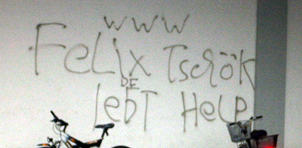
We received some e-mails three days ago informing us that various graffities related to Felix Tschök had appeared at the shopping centre on Rummelsburger Strasse in Berlin-Schöneweide within 24 hours. We were irritated, shocked, nervous and baffled, all at the same time. Particularly the information that somebody wanted to kill him concerned us a great deal. We could not gauge who or what was behind this campaign. Dresden CID informed us about its work the day before yesterday.

The Berlin State Office of Criminal Investigation started its work to discover the perpetrator and the background to the graffities.

29. April 2011
DNA

Dresden CID informed us about this too: A young man had gone to the police a few weeks ago, claiming to be Felix Tschök. He voluntarily gave a saliva sample for a DNA test to prove the truth of this statement. The Berlin graffities had been created during the time between the handover of the saliva sample and the conclusion of the necessary tests. The result of the DNA test was now available – and proved that he was not Felix.

Berlin Graffities, 2011 Berlin Graffities, 2011 Berlin Graffities, 2011
29. December 2013
Online

We had been repeatedly asked during the last few months and during the years previously whether there was really nothing new to report in the search for Felix.

Regardless of this, individuals in the circle of those interested in our case repeatedly made suggestions about what or whom we should specifically question or look for. Groups looking for Felix were formed on social media , e.g. at www.vk.com (a network in Russia – “In Contact”), and networks were searched for possible candidates etc. Every now and again, an editorial department from a newspaper or a TV channel got in touch and wanted to report on our story again. We avoided these requests last year, as the editorial departments only wanted to fulfil their so-called duty to chronicle events, in our experience. The journalists did not have the time or, above all, the financial resources to actively resolve the matter in order to get a little closer to finding Felix. The language barrier was also a significant factor.

19. March 2014
Moscow

The German embassy in Moscow contacted us. The colleagues there informed us about a conversation that had taken place recently with the so-called investigative committee of the Russian state prosecution service (the investigative committee is the highest body in Russia among the criminal prosecution authorities). It reported that they had found a large number of young men, who might play a role in our case, during the last few years. It asked for patience because detailed investigations needed to be performed in about 400 cases. The positive aspect about this news was that there was still no final report.

23. January 2015
Limitation

Dresden state prosecution service was no longer actively looking for Felix. The crime was subject to the statute of limitations. The criminals could no longer face trial before a German court. Would we now receive the answer to our question – “Where is Felix?”

The background to this is the fact that, after more than 30 years, the final judicial possibility, the final legal basis, under which investigative work could still be actively conducted, had been exhausted. If some new information arose at some stage, further work would naturally take place on this missing person case.

10. October 2015
Contact

We saw a call from a phone number in the Russian Federation on our land line phone. We asked our Russian friend, Andrej, to return the call: the caller was Yuri from Kaliningrad. He explained that he had some information for us, but only wanted to reveal it in a personal conversation. We should visit him in Kaliningrad!

13.07.2016
Kaliningrad

We arranged to meet our Russian friend, Andrej, during our summer holidays in Moscow and St. Petersburg. Andrej arranged the visit with Yuri in Kaliningrad and flew with ‘Ebs’ from St. Petersburg to Kaliningrad without further ado.

The visit mainly took place in a garage that Yuri had converted into a workshop with a living room feel. He told us that he was stationed as a KGB agent in Dresden in 1984/1985 under the guise of a member of the military state prosecution service. He managed to find the nurse in May 1985 who had looked after the foundling in the so-called “Lower Hospital” for the Soviet forces in Germany in Dresden in 1984. His superior had forbidden him from directly talking to her.

Using Russian social networks, Andrej had managed track down the nurse a bit later, and he was able to talk to her on the phone. She confirmed that she had worked at the hospital, but could not remember anything. Andrej believed that it was more likely that she was not allowed to remember anything.

As we left, Yuri gave us a striking picture including pieces of amber; it was about as large as an A4 sheet of paper.